 |
| Kellie Schneider's "Dance of the Sugar Plum Fairy" illustration
Review by Janet I. Martineau
It was an embarrassment of "Nutcracker" riches Tuesday night when the Saginaw Bay Symphony Orchestra presented its annual Christmas concert at the Temple Theatre. And not all of them involved music. In fact, eight of them were gorgeously and whimsically visual. On paper, maestro Brett Mitchell's program for the night looked, well, um, kinda pedestrian. Enter Saginaw-born artist Kellie Schneider, jazz musicians Duke Ellington and Billy Strayhorn's creativity, elegant and colorful staging, tuned bells, and orchestra members shining in an unusual number of solo samplings. Now, how to boil it all down in a few words. To enhance the playing of that old warhorse, Tchaikovsky's "The Nutcracker Suite," Mitchell commissioned Schneider, now living in Minnesota, to create an illustration to project overhead for each of its eight segments -- among them the dance of the Sugar Plum Fairy, the ethic dances, the dance of the reed pipes, and the waltz of the flowers. The renderings were utterly charming and magical, with a nature-linked recurring image of trees or tree branches in most of them, snow flakes falling, an oversized red Chinese fan in one and a castle-like background in another, eye-pleasing light and shadow plays, childlike and playful people in them yet sophisticated too. Sometimes we sorta tuned out the music being played, just to wallow in the examination of the art....but not for long as we realized the orchestra was beautifully playing the score. And the came "Nutcracker" two -- the Ellington/Strayhorn five-segment jazz take on Tchaikovsky's classical fare. With its segments renamed "Toot Toot Tootie Toot," "Sugar Rum Cherry" and "Peanut Brittle Brigade," for three. Oh my goodness what fun, with the cherry one via sugar plum soooo smooth and sultry and HOT. And the orchestra proved it can masquerade as one mean jazz-playing machine with strings attached. Between these two pieces, goosebumpy solo segments were delivered by Margot Box on harp, Catherine McMichael on celeste, John Nichol on sax, Kennen White on clarinet, John Hill on percussion, Andrew Mitchell on trombone, Gregg Emerson Powell on bass, and Mark Flegg on trumpet. The tuned bells were used in Mozart's "Sleigh Ride," and created we must say a worthy unusual sound, different from regular run-of-the-mill sleigh bells. LOVED, LOVED the playing of the overture to Humperdinck's "Hansel and Gretel" -- an operetta we adore and which is staged way too rarely. And McMichael on piano and a combo gave a jazz feel to the opening of "Santa Claus Is Coming to Town" -- part of Mitchell's inventive programming that offered a classical first half and a jazz second half. The staging echoed the classical/jazz division with traditional Christmas trees in the first half to which was added the trunks of palm trees in the second, with the lighting more cool in the first half and hotter in the second. And Mitchell was in a humorous mood which served the night well, even when a technical snafu surfaced and ended with him exclaiming, rightfully, "Mercy!" |
Wednesday, December 11, 2013
Saginaw Bay Symphony Orchestra goes jazzy and adds an art exhibition too

Thursday, December 5, 2013
Bay City Players production of "Les Miserables" shines in ensemble numbers
 |
| From left, Laurel Hammis, Denyse Clayton, David Clayton, Dan Taylor |
 |
| Matt Schramm, Carly Peil |
Review by Janet I. Martineau
Photos by Kunio Ouellette
"Les Miserables" No. 1 is up and running in the Tri-City community theater realm.
It opened Thursday night at the Bay City Players....and in the near-capacity audience was a contingent of creatives from the Midland Center for the Arts, where "Les Miz" is scheduled to open in late March. Included among them the director and the music conductor.
Hmmmmm....being supportive or running reconnaissance? Or maybe just there to see the Midlanders who were in the cast.
Whatever the case, we wonder if they thought it was a mixed bag, as I did.
There were, to be sure, superb moments in this version directed by Mike Wisniewski with music direction by Sara Taylor.
First and foremost the chorus/ensemble work was outstanding. It was there where some the best singing AND acting surfaced. The factory workers, the street whores, the beggars, the inn customers , in particular the student revolutionaries....their faces were full of emotion, their body English rang true, their singing voices were rich in mini-solos and full ensemble.
With them the production soared.
And it soared with several of the supporting roles.
David Clayton and Denyse Clayton, married in real life, tore up the place as the ribald, uncouth and greedy innkeepers. Granted this is a role that normally steals segments of the show. But these two, acting pros that they are, were diction perfect, full of expressions and movement eye candy, acting as if this awful behavior is second nature to them, totally comfortable in their roles.
So too was...and this was a surprise since he is a newcomer to us...Matt Schramm as Marius, the leader of the student revolutionaries. Schramm, a Presbyterian minister by occupation, has a singing voice to absolutely die for and an equally impressive acting range.
Faced with depicting about every emotion known to man, Schramm delivered all of them equally, as if he were really living the part. His "Empty Chairs at Empty Tables" solo was heartbreaking in its raw intensity.
Shawn Penning, a 9th grader, served up a performance beyond his years as the cocky street urchin who joins the revolutionaries. And young Laurel Hammis (no grade or age given) had the right vulnerability as young Cosette down pat and sang with excellent clarity.
Which leaves us the leads -- Dan Taylor as Jean Valjean, Dale Bills as Javert, Jennifer Kennedy as Fantine, Carly Peil as Eponine and Kalie Schnabel as the adult Cosette.
None of them is 100 percent there yet. Close, most of them, but not quite there. Some sang at the full percentage, but were not settled into their characters lock, stock and strong acting barrel (Taylor for one, who hit killer notes throughout). Others were acting at full throttle but there were some singing issues (Peil among them, whose Eponine was spot on but in "On My Own" she undersang it).
This is not to say their performances were bad. In no way were they bad. It's just that they can be better ...and we say that knowing this musical is a minefield.
Other plusses: Sara Taylor and musicians were strong throughout. Choreographer Holly Bills moved this massive cast well and she and the director created attractive tableaus.
Other negatives: The set....the decision to downplay the set and make it minimalist, well, we think it went a little too far in that aspect. The Javert suicide scene did not work. Some of the costuming was questionable. And a couple of sound system issues destroyed moods.
In the final analysis, as the show progresses through its run we suspect the majority of the negatives will turn positive.
 |
| One of the excellent ensemble groups: the street whores |
I
Busy sound effects man propels SVSU's annual radio play production
 review by janet i. martineau
photo courtesy of SVSU
So, just for the fun of it, I decided to count how many cues the sound effects man had to contend with Wednesday night when Saginaw Valley State University opened its short run of the classic "Miracle on 34th Street," done in 1940s radio play style.
69 cues, people. In one hour. Door opening and closing. Courtroom gavel. Phone ringing and receiver slammed down. Feet walking and newspapers rustling. A punch in the snout and photoflashes. Dinner dishes rattling. Chimes. Endless bags of mail going plop. And more.
Yep, no doubt about it Blake Mazur was the busiest of the cast members In this fourth annual SVSU production of a 1940s radio show -- keeping on task while his character continually poured libations from a flask and sometimes mouthed or mimed the action taking place before him.
Great fun, these mock radio shows, as the casts present a show within a show -- seriously acting their parts in the play's storyline and engaging in all sorts of out-of-character shenanigans since with radio shows the audience never were able to see what the actors were doing so they could do just about anything.
Thus we had doddering Lexee Longwell and extremely extremely nervous Dakotah Myers who were just fine when they stood up at the microphone as their characters. Others munched on snacks, drank pop, talked silently among themselves.
17 students were involved in this production, some playing just one role and others two or three roles. It never fails to amuse when a full-bodied adult stands up to the microphone and out comes a squeaky little child voice. Co-directors/play adapters Ric Roberts and Dave Rzeszutek kept all 17 busy always doing something somewhere somehow.
The commercials are always fun in these productions. This year there was the annual tribute to downtown Saginaw's Savoy restaurant, of course. But also advertised was 7-Up, Campbell's soup, and the long-gone Morley Brothers in downtown Saginaw.
The story line had the owners of Macy's and Gimbels in New York City doing battle, plenty of word play, and parts for the co-directors as well. Adding dramatic emphasis was Kevin Simons on organ.
And 1940s period dress was the icing on the cake.
When we say short run, "Miracle" is presented only twice. The second performance is at 7:30pm Thursday, Dec. 5.
Thursday, November 21, 2013
"The Producers" a top-notch birthday gift at Saginaw Valley State University
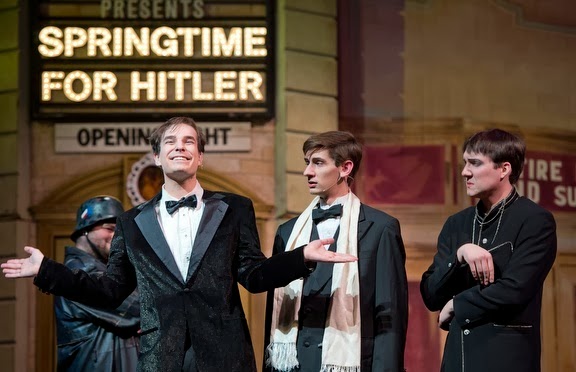 |
| Keith Schnabel, Isaac Wood and Blake Mazur |
 |
| Schnabel as Hitler with director Ric Roberts second from right |
 |
| Wood, Lexee Longwell and Dakotah Myers |
review by Janet I. Martineau/ photos by Michael Randolph
Detail.
Detail.
Detail.
The devil is in the detail.
We have said that for nigh unto 40 years of reviewing theater.
And the Saginaw Valley State University 50th anniversary production of the Mel Brooks musical "The Producers" is beautifully awash in it.
The show opened Wednesday night to a capacity audience, enticed there perhaps by the much-publicized fact the college had rented the actual Broadway set, props and costumes that helped earn the show 12 Tony Awards back In 2001.
And yes, what a wonderful gesture that a university would so reward its theater department with a budget and confidence in celebration of the school's 50th. Impressive. That set was indeed gorgeous, and the props and costumes ever so rich, keeping the backstage crew hopping cleanly and with darn few glitches.
But what the audience got in addition to that was acting and sight gags awash in detail, detail, detail.
Director Ric Roberts and his 28-member cast have been rehearsing since May, a breathtaking six months, this first musical theater collaboration of the departments of theater and music and easily SVSU's biggest production ever.
It shows.
Every performance shines with delightful bits of business that make the characters real. The enunciation is crystal clear. The singing and dancing spot on. The energy explodes. Standouts and show stoppers are everywhere.
And yet, it is all kept in marvelous check.
"The Producers" is a farce, a spoof of musical theater, the story of two men seeking to produce the worst-ever musical so they can bilk a million or two. It offends left and right -- homosexuals, actors, old women, Hitler, Swedes, show business. It could so easily go too far over the top. But Roberts and his cast keep it in check.
Dakotah Myers in the Nathan Lane role and Isaac Wood in the Matthew Broderick role as the two producers are funny and charming, with gorgeous signing voices.
David Ryan as the Hitler-loving writer of the bad musical "Springtime for Hitler" nearly steals the show with his roof-top pigeons during "In Old Bavaria" ....but then comes along Keith Schnabel and Blake Mazur as the bad director and his partner, with six others in their employ, in "Keep It Gay"....but then comes along Lexee Longwell as the Swedish bombshell bad actress in "When You Got It, Flaunt It"....but then comes along a chorus of little old ladies and their walkers singing and dancing in "Along Came Bialy."
Watch the detailing in these performances, the energy, the strong voices, the reality of their characterizations despite being weirdo characters.
Schnabel later returns as the singing and dancing Hitler, with a hint of Charlie Chaplin thrown in, in a second scene stealing attempt. Myers shines in the difficult singing soliloquy "Betrayed." And director/tenor Roberts puts himself in the show stopper number "Springtime for Hitler" a la Busby Berkeley.
And the ensemble members supporting them are also richly nuanced in their performances.
Bravo too to Roberts for outstanding choreography, which the cast executes like old pros, and assorted sight gags. And down in the pit, conductor Kevin Simons oversees a 16-member orchestra filled with music department teachers and other area professionals who are stellar as well.
This year is a hallmark one in mid-Michigan theater, one in which companies bit off huge shows to tackle and so far have totally exceeded the expectations of this reviewer.
The Midland Center for the Arts took the badly written "Dracula" and gave it soaring production and acting values.
Pit and Balcony Community Theater delivered a hilarious and technically challenging "Young Frankenstein," another Mel Brooks creation.
SVSU chimed in with this Broadway set, props and costumes birthday gift that delivered acting chops galore. ("The Producers" runs through Sunday.)
Can't wait to see what the Bay City Players deliver next month with the biggie "Les Miserables."
Tuesday, November 5, 2013
Suzie Reid's "A Collection of Trees" art rooted in her lifelong issues
 |
| Saginaw Township artist Suzie Reid with three of her tree pieces |
story and photos by janet i. martineau
On Thursday (Nov. 7 ), Saginaw Township artist Suzie Reid is taking a “Healthy Stand” at the Andersen Enrichment Center, 120 Ezra Rust...
...With her “A Collection of Trees” pieces collectively thus titled, created in the fine, fine art called pointillism -- using a micro-fine pen one tiny, tiny tip-point dot at a time until a piece is finished.
Why trees in the 8 1/2-inch by 11-inch pieces?
“Because I love their strength. That they are deeply rooted and I never have been. The fact they shed everything and then they begin anew.”
As Reid soon reveals, she has spent a lifetime battling depression, obsessive-compulsive disorder, bipolar issues and social anxiety as well as a smoking addiction -- “and the labels, stigmas people put on you because of it; how they might see you.”
Finally, with counseling and medications, for the past decade she has been on more of an even keel -- with counseling and medications AND getting lost in her art.
“It’s a big risk for me, doing this art show and talking about mental illness, but it is who I am and it is important to me to put it out there and hopefully destigmatize mental disorders and addiction. To suggest a path to wellness.”
So, she says, she rented a room at the Andersen, made affordable prints of 10 of her trees, framed some of them in unusual frames, and will hold forth from 3pm to 7pm Thursday to “open the lines of communication.”
And while each tree drawing has a theme about her lifelong battles and contains related words amid its branches, “from a distance they are just trees. You have to get up close to see the words.”
Saginawians may remember Reid who created Victorian houses out of Saginaw bricks and painted Michigan lighthouses on glass, among other themed art, and was a familiar face at art fairs. She also, over the years, has worked on set design at Pit and Balcony Community Theatre.
 |
| "When Lightning Strikes" |
This new bent with pointillism she calls “very freeing, therapeutic, liberating” as she gets lost in the mechanics and any sense of time vanishes. She creates a basic outline, next come the branches and trunk, and then she fills in the twigs “and by this point I know where I am going with the verbiage. I have found the meaning of the tree.”
Some are created in a day; others may take up to a week. “You can make tons of mistakes with this art form and work them in. There is the fun of working with shadows and light -- figuring what way the sun is coming from.”
Among the titles of the the pieces are “Happy Face,” “Stunted,” “Deep Pockets,” “Stuck,” “Can’t Catch Me,” “When Lightning Strikes,” “Flagging Meadow,” and “In the Pits.”
The framed ones are framed in black oversized frames “because black speaks to depression. But they are unusual fames in that they are made of leather, linen
She will, on Thursday, discuss some of her emotions behind each piece -- what it is depicting and the finer points of the words -- if visitors wish. Or they can just enjoy the art at face value with its intricate dot patterns creating tree forms.
But just to offer a hint, “When Lightning Strikes” depicts a tree split in half.
“We had this pear tree that was hit by lightning and split practically in half. Yet it still produced pears. This is symbolic of being bipolar. I cried when I was diagnosed. I didn’t want to be bipolar. But I was told, ‘You have no idea how many of our patients are.’”
Reid says she thinks society just focuses on the bipolar people who make headlines for their behavior, not realizing the hush, hush of people who are dealing with it effectively.
Next up Reid plans to explore “Family Facades” as a theme, using the old marble and granite architecture of Chicago as a basis.
Wednesday, October 30, 2013
Wynton Marsalis, Jazz at Lincoln Center Orchestra headed for December gig at Temple Theatre
by janet i. martineau
A big-name jazz orchestra and its Grammy-winning leader are headed to Saginaw’s Temple Theatre for a Sunday, Dec. 8, concert.
Trumpet player/composer/educator Wynton Marsalis and the 14-member Jazz at Lincoln Center Orchestra will perform their “Big Band Holidays” touring program. And opening the 5pm concert is the 18-member Michigan Jazz Trail Big Band with three guest singers.
 |
| Wynton Marsalis |
Tickets, on sale at the Temple, are $75 for VIP in the first two rows (included is a meet and greet with Marsalis), $55 for main floor rows C – O, and $35 for main floor rows P-AA and the balcony.
Student tickets are available at $25 in the $35 sections. And there is a family pack available at a 10 percent discount (2 adults, 2 children).
Marsalis, 51, is a native of New Orleans. He attended the famed Juilliard School of Music, is the managing and artistic director of Jazz at Lincoln Center, the winner of an astounding nine Grammys for classical and jazz music and one Pulitzer for an oratorio, has penned six books, and hosted Peabody-winning educational series on PBS and NPR (to name just a few of his long list of credits).
In 1995 Time magazine named him as one of America’s most promising leaders under age 40 and in 1996 designated him as one America’s 25 most influential people. Life magazine named Marsalis as one of the “Most Influential Boomers.”
And in the summer of 2014, he will become the director of jazz studies at Juilliard.
The Jazz at Lincoln Center Orchestra began in 1987 as a summer concert series; by 1991 became an official department at the New York City performance venue (home also to the New York Philharmonic, Metropolitan Opera and New York City Ballet), and in 2004 opened its own performance facility there, one designed for the sound, function and feeling of jazz.
Marsalis founded the orchestra. Its players are top-rated soloists, ensemble players and jazz arrangers.
Annually the orchestra and Marsalis tour worldwide and perform in collaborations with many of the world’s top symphony orchestras as well as presenting their own headliner concerts. Over the years the orchestra also has premiered pieces Marsalis composed.
 The Saginaw concert is the brainchild of Midlander Molly McFadden, who started the Michigan Jazz Trail Festival organization in 2010 as a way to honor the state’s rich jazz heritage and provide a Great Lakes Bay Region celebration of it.
In addition to forming its 18-piece big band, comprised of select regional players and conducted by Jim Hohmeyer, Michigan Jazz Trail has sponsored regional jazz festivals, hosted jazz clinics for high school students, and partnered with other non-profits to present programs.
In 2014, Michigan Jazz Trail is planning to produce regional jazz festivals in Saginaw, Midland, Bay City, Tawas and Charlevoix.
Says McFadden of the Marsalis booking, “The musicians in the Michigan Jazz Trail Big Band want to raise the bar in their performing, and this is a Christmas gift to them for their past four years of providing first-rate concerts, for their love of jazz, and for their loyalty to the mission and the vision of the Michigan Jazz Trail Festival.”
Performing with the Michigan Jazz Trail band at the Marsalis concert are McFadden, a former New York City cabaret singer; Julie Mulady, a singer with the Brush Street combo, and Dacia Mackey, a recent Arthur Hill High School graduate and a soloist with the Saginaw ACT-SO program sponsored by the Saginaw branch of the NAACP.
The Dec. 8 concert is funded in part by a grant from the Saginaw Community Foundation’s Senior Citizen Enrichment Fund.
The Temple Theatre is located at 203 N. Washington. To order tickets, call (989) 754-7469. They also are available online at www.templetheatre.com.
Tuesday, October 22, 2013
Bay City Players' "Moonglow" puts humor into the Alzheimer's situation
 |
| Debbie Lake, Debra Monroe, Margaret Bird, Leeds Bird |
review by janet i. martineau/photos by kunio ouellette
A comedy....about Alzheimer’s....one in which gales of laughter sweep the theater at the Bay City Players.
Who would have ever guessed.
And that it was penned by Michigan playwright/Wayne State graduate Kim Carney, with plenty of Mitten State references, adds to the fun.
Yes, fun, about Alzheimer’s.
We’re talking about “Moonglow,” which opened this past weekend and continues this coming weekend.
Thanks to its script and its stupendous casting in Bay City, this is a don’t miss production that is respectful both of the disease and old age, that will at the end leave you in tears after all that laughter (especially if you are still trying to cope with your own mother’s death even if she did not die from dementia), and that will make you realize we’re all in this together as it captures in sight and words the aging process that will claim us all. (We suspect the older you are, the funnier this show is because, well, you see yourself).
What is best about it, however, is the casting -- some of the area’s top notch actors -- and its strong direction by Tina Sills.
Leeds and Margaret Bird, a real-life married couple “up there” in years, are cast as two residents of an Alzheimer’s care facility. Debbie Lake of Saginaw is the anxiety-ridden daughter who has just placed her reluctant and angry mother (Margaret Bird) in that facility. Kurt Miller is the son the Leeds Bird character no longer recognizes. Debra Monroe is the head caretaker at the facility -- routinely caught between the patients and their overbearing children.
 |
| Kate Sarafolean, Dave Newsham |
And in the play’s trickiest casting are Dave Newsham and Kate Sarafolean as the Alzheimer’s duo in the 1940s, when they were young. Sometimes all four share the stage, shadow or mirror each others movements, speak in tandem. Other times they drift on and off like ghosts. In the final scene...well....we’ll we don’t want to spoil its discovery but in the final scene one of them talks from beyond this world as her body lies before us.
It is tricky writing, tricky casting and tricky direction to carry it off. If there is one issue it is that the younger couple in no way resemble the older couple in terms of height. But that is a minor moot point.
This younger pair also, whether this is intentional or not, create a little confusion in our minds now and then....confusion on who is who that Alzheimer’s patients suffer.
Leeds Bird is the powerhouse of the acting ensemble. Every fiber of his being is a confused old man -- the way his face contorts, picking at his arms, shuffling in his gait, trying to make a craft as the old lady bosses his every move until he erupts, confident still in his dance skills.
Lake too delivers a moving performance as a daughter trying to convince her mother this care facility is the right move, reacting with total astonishment and delight when something kinda warm and fuzzy happens, refusing to acknowledge the reality of Alzheimer’s, and that killer scene at the end.
But Margaret Bird, Monroe and Miller are right in lock step too with their characterizations. What is fascinating is the show also gently but effectively deals with the plight of adult children coming to terms with parents who have Alzheimer’s and some of the issues care facility staff have to deal with.
The play spans the course of one year (1997, the year the playwright’s mother died of Alzheimer’s) at that facility, its one-scene set (designed by Leeds Bird) effectively used in allowing the motion to continue uninterrupted by set changes.
So many many of the Alzheimer’s-related movies we have seen have been total downers. “Moonglow” offers another viewpoint to consider, one that is compassionate yes but also finds a way to add humor to its complexities.
Subscribe to:
Posts (Atom)