Saturday, October 1, 2011

Pit and Balcony's "Great American Trailer Park" a good night of redneck fun

review by Janet I. Martineau
This here musical that opened Friday night at Pit and Balcony Community Theatre, well, it’s ain’t your “Sound of Music” kind of show. Even thought it’s about family...more precisely kin.
Nope. It’s about road kill, a malfunctioning electric chair, adultery, a stripper, a fake pregnancy, agoraphobia and Walmart -- all set in a trashy trailer park in Florida.
We’d call its cast of characters redneck white trash. But, ya know,  they kinda grow on you.
It’s titled “The Great American Trailer Park Musical” and it is irreverent, quirky,  kinda profane, NOT politically correct ...and way loads of fun as directed by James Gaertner.
It’s cast of seven stays in glorious seedy character (just barely on the safe side and not caricature) and high energy throughout. The ever-changing costuming is clever and appropriately cheesy as is the trailer park set.  Brian Farnham’s choreography moves things along very well and also is clever, particularly  in “Flushed Down the Pipes” and “The Great American TV Show.”
Just add on that wacky script and score, by David Nehls and Betsy Kelso, and whatta ride. One sample of the lyrics: “Like clothes from Walmart, my life is falling apart.” And the musical styles include blues, gospel, country rock, rhythm and blues.
If there is one criticism, and we might as well address it now, it is DICTION. Since this is a show that is primarily sung rather than spoken, and the real humor lies in its lyrics, making sure every word is crystal clear is paramount.
Jessica McFarland as the timid housewife afraid to leave her trailer  and Christy Horn as the brassy stripper understand that and deliver. But the rest of the cast needs work slowing down just a bit and enunciating more clearly -- particularly the  lawn-chair sitting Jessica Booth-Asiala, Lucy Malacos and Brooke Pieschke, a Greek chorus providing commentary and playing assorted mini-roles. Each of them has moments of great clarity, but then are given to mush.
Speaking of McFarland and Horn, they are the brightest lights in the show with the  best of the singing voices and playing two  diverse characters that break our heart.
Horn’s pole dance shows early on she has locked into her character totally while with McFarland we watch with tender concern as her sadsack character inch by inch leaves the trailer.
And when they duet on “But He’s Mine” they deliver goosebumps for their emotions, vocal prowess and ability to nail a song in unison.
Then Horn returns to sing -- make that spit out with seething raw emotion  -- about getting on with her life and the goosebumps fester.
So give this show a try. It ain’t intellectual and profound and big ticket like the big-name musicals. But it sure is fun.

Thursday, September 29, 2011

Little Rock Nine's Minnijean Brown Trickey offers words of wisdom at SVSU

by Janet I. Martineau
When it came to discussing her place in history, Minnijean Brown Trickey did not mince words on Monday night when she spoke at Saginaw Valley State University as a Dow Visiting Scholar.
“If you want an All-American hero, then I am it,” the 70-year-old said, her voice rising. “Eat your heart out Lady Gaga, Britney.”
She can, after all, lay to claim that there is a statue of her in Little Rock, Ark. -- a rarity for people who are still living.
Trickey’s presentation was, well, tricky.
Minijean today....
Some people in her audience (myself included) knew exactly what happened to her 54 years ago this month, in the days in and around her 16th birthday (and my 12th). And we are forever bound together by the pain of it.
But the majority of her audience were SVSU students who had no idea.
Because what happened to her is not taught in history classes in America, she alleged.
“There is a unit about it in New Zealand history classes, in South African history classes,  in Belfast and the rest of the United Kingdom,  but not here.”
Trickey was a member of the Little Rock Nine -- nine black teen-agers who, on Sept. 2, 1957,  voluntarily tried to enter the segregated (as in all-white) Little Rock Central High School. 
It was a major moment in the Civil Rights movement, and set off an epic battle between the  door-blocking Arkansas National Guard and the eventual door-opening U.S. Army --  complete with weapons, tanks and helicopters.
“I’m just going to school,” Trickey repeated several times Monday night, quoting from a poem about the event. And for that she and the eight others -- three boys and five girls -- were spit upon by screaming mobs, some of their parents lost their jobs, and their families endured endless obscenity-laced telephone calls threatening death and worse.
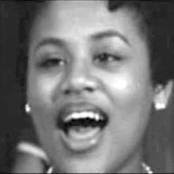
...and in 1957
“They thew away their dignity and it landed on us,” she said of the state's national guard and crush of screaming whites.
“Look it up on Google,” she told the SVSU students. “Our lawyer back then was Thurgood Marshall. He was very cute. Look him up on Google too.”
In her “Return to Little Rock” lecture, Trickey showed black and white news footage -- that’s all there was back then -- of the confrontation. Of herself speaking to the cameras. Of the soldiers, the Ku Klux Klan, the venom spewed by white students and the Arkansas governor.
Soon into her hour-long talk, it became clear Trickey is still the person she was back then, the passionate and outspoken and society-challenging social activist kid who is now a senior citizen. But, she said more than once as well, do not mistake her words for anger “but for sorrow, for sorrow. I spent many years thinking I was angry, but it really was sorrow.
“In those years we used to hide under our desks from the Russians, but the enemy was not outside the U.S. It was right down the street. (What happened) to us ain’t about black history. It’s about American history.
“The things I believed in (liberty  and justice for all) were shattered. Seeing the guy (police officer) with the gun and the stick shaking as he drove us out of the school and into the street...so afraid of his own people. That it took three weeks for the federal government to get its act together and send the 101st Airborne so we could finally enter  the school on Sept. 25....”
Quoting James Baldwin, she said the Little Rock Nine crisis was an example of “history being more beautiful and terrible than we know.” Had she, her eight friends and their families known the years of abuse that would follow, she admitted, they might not have taken the path that ultimately changed American education. “But then we would have missed something too.”
In the years since, Trickey earned bachelor’s and master’s degrees in social work, raised six children,  received the prestigious  U.S. Congressional Gold Medal as well as numerous other awards, and, during the Clinton administration, served as a deputy assistant secretary of the Department of Interior. Now living in Little Rock again, she  also has been the subject of two documentaries.
But, she noted, she has not written her memoir yet “because I find words are insufficient;  the Little Rock crisis was American terrorism at its finest.”
The Little Rock Nine under federal escort
In linking that 54-year past to the present, Trickey said that “scores of silent witnesses stood by and did nothing” back then, adding that  such behavior continues today  with “the fill-in-the-blank people we hate this week. I urge you to be a traitor to the narrow-mindedness we have in this country. 
She asked all  people to “find their common ground; don’t tell me how different we are” and to learn and practice the values of non-violence.
She suspects the Little Rock Nine story is hidden in American history “because nobody wants you to know 14 and 15 year old boys and girls changed the world; that ordinary teen-agers stretched themselves to the find their courage for the cause of eduction” and that she is looking for that same courage today.
“We still have throwaway children in a land of democracy; underfunded schools.”
As for that statue of her -- each of the Little Rock Nine has a statue, in view of the governor’s office in Little Rock, with each  allowed to pick a quote to appear on his or her statue.
Minnijean Brown Trickey says she turned to the words of Gandhi for hers:
“Be the change you want to see in the world.”

For the names of the Little Rock Nine and what became of them, log on to the slightly outdated http://www.centralhigh57.org/The_Little_Rock_Nine.html

Wednesday, August 31, 2011

Take a trip back in time inside Michigan's one-room schoolhouses


Sanford Village one-room schoolhouse, 1897

by Janet I. Martineau
Surprise fact... today about a dozen one-room schoolhouses are still engaged in educating students  in Michigan.
Avid historian Kyle Bagnall will discuss them and their vanished or revamped cousins during the Wednesday, Sept. 7, Nurturing Nature series program on “Michigan’s One-Room Schoolhouses.”  His presentation begins at 7 p.m. at the Green Point Environmental Learning Center, 3010 Maple in Saginaw .
“The Michigan One-Room Schoolhouse Association has completed an inventory of more than 7,000 schoolhouses in our state,” says Bagnall, the historian at the Chippewa Nature Center in Midland.
“Thousands of them still dot the landscape, though many are gone and a great number them have fallen into disrepair. Today, some in our area are being used as churches and private homes, museums, township halls and more.”
Bagnall says  his program will provide a short overview of Michigan education history before focusing in on the one-room schools of mid-Michigan.
“When our State Constitution was drafted in 1835, Michigan quickly became a national leader in education. It’s good to remember where we’ve been as we consider the future of education in our state.”
Bagnall’s interest in historic schoolhouses began about 20 years ago when he was working on a college project about  inactive cemeteries with abandoned one-room schools next door. “The schoolhouse proved too interesting to let be and another project was born.”
In the course of presenting the program over the years, Bagnall says members of his audiences add to the one-room schoolhouse stories from their own personal histories.
Most stories from former one-room school kids (and teachers) recall subjects like recess, outhouses, and mischief that children (mostly boys) created over the years. Some things never change – kids will be kids!”
Admission to “Michigan’s One-Room Schoolhouses” is free to members of the Friends of the Shiawassee National Refuge and $2 to non-members. Support for the series is provided by the Jury Foundation, the Martineau Family Foundation and the Saginaw Branch of the Woman’s National Farm & Garden Association.

Wednesday, August 17, 2011

Ohio resident David Baker winner of Theodore Roethke Memorial Poetry Prize

by Janet I. Martineau
Poet David Baker and his 2009 book “Never-Ending Birds” were announced today as the recipients of the 12th triennial Theodore Roethke Memorial Poetry Prize -- a $10,000 stipend awarded by the Saginaw Valley State University Board of Fellows.

It is a fitting selection for the prize named in honor of the Saginaw-born poet who won the Pulitzer Prize for poetry capturing the natural world --  of the family greenhouses on Gratiot as well as mid-Michigan rivers and critters -- along with his childhood memories of Saginawians.

Wrote the Poetry Foundation of Baker, “He is often described as a poet of place, indebted to the American Romantic tradition of Emerson and Whitman, as well as Frost. His poems typically explore an individual’s sense of and engagement with their natural surroundings, and embrace complicated notions of history, home and memory. And Baker himself has delineated the importance of landscape and place to his poetry.”

Adds poet David Wagoner, one of two judges who chose  Baker as the winner of the Roethke Prize, “I think Theodore Roethke would have been especially pleased that the prize in his name is being given to David Baker because he believed that sound, rhythm and meaning were of nearly equal importance in the making of a poem, and (Baker’s)  beautiful and skillfully made book ‘Never-Ending Birds’ clearly demonstrates he believes so too.” 

Baker, who lives in Granville, Ohio, will receive the prize during a free public ceremony, starting at  7 p.m.  Tuesday, Nov. 15, in the Rhea Miller Recital Hall at SVSU. That event is  part of a five-day Theodore Roethke Poetry & Arts Festival taking place not only at SVSU but at venues in Saginaw, Midland and Bay City.
A professor of English and the Thomas B. Fordham Chair of Creative Writing at Denison University, 56-year-old Baker has written 10 books of poetry and is the poetry editor of the Kenyon Review. His poems and essays also have appeared in more than 100 magazines, including American Poetry Review, The Atlantic Monthly, The New Yorker and the Yale Review, and countless anthologies. 
Although born in Maine, Baker was raised in Missouri and has spent more than 40 years of his life in the Midwest -- including teaching for a year, in 1996, at the University of Michigan in Ann Arbor, where Roethke received his bachelor and masters degrees.. 
In an online interview with Paul Holler, Baker said of his work, “I find a connection between my poetry and my place in the world. I am sure that my work would be different if I lived a long time somewhere else; of course it would, though I have no real way of estimating what that would be, how my poems would change. 
“As it is, I can't see how I could write without a devout attention to place — the language, ways of life, my neighbors and family, the rigor and leisure that grow here where I live.”
Among his other poetry books are “Midwest Eclogue,” “The Truth About Small Towns” and “Sweet Home, Saturday Night.”
The Roethke Poetry Prize, which began in 1968,  is unusual in that poets do not submit their works in hopes of winning it. Instead, the current U.S. poet laureate choses two or three published poets who then select a winner after reading poetry books published in the past three years. 
Serving as a judge with Wagoner  was  Rosanna Warren, who praised the sensory nature of Baker’s work.
“He understands the human story as part of a larger story of life on earth, but he never forces the analogy,” she said. “His rhythms are as alive to the roll and tang of syllables on the tongue as they are to the recurrences and interruptions of the circulation of blood and sap. His poems respond deeply to life, and enlarge our imaginative responses to it.”
What is interesting is that both judges have  links to Roethke and/or the prize.
Wagoner was a student of Roethke’s  and wrote a play about his teacher, “First Class.” He did a reading of the play at Saginaw’s First Presbyterian Church, Roethke’s church, when he was here in 2009 as a guest of the Friends of Theodore Roethke.
Friends of Theodore Roethke own and operate Roethke’s boyhood home at 1805 Gratiot.
Wagoner also selected and arranged the book “Straw for the Fire: From the Notebooks of Theodore Roethke, 1943-63.”
And Warren is the daughter of Robert Penn Warren, a former U.S. poet laureate who won the Roethke Prize in 1971.
Roethke was born in 1908 and died in 1963, and in 1954 won the Pulitzer for “The Waking.” Although he was teaching at the University of Washington in Seattle at the time of his death, he is buried in Saginaw.
For the title poem of Baker’s  winning book, log on to http://www.newyorker.com/fiction/poetry/2007/06/04/070604po_poem_baker
To hear Baker reading his poetry, and an interview, log on to http://www.youtube.com/watch?v=0gcCluuEfUg.
And for more information on the five-day Roethke Festival, log on to http://www.svsu.edu/roethke.

Wednesday, August 3, 2011

It's time to start training for the Wild Goose Chase at the Shiawassee National Wildlife Refuge

by Janet I. Martineau
Forget about running with the bulls in Spain....how about running with the deer at the Shiawassee National Wildlife Refuge in Saginaw, Michigan.
Or walking amid them and other wild critters.
The refuge and the Friends of the Shiawassee National Wildlife Refuge volunteers are co-sponsoring the third Wild Goose Chase 5K run/walk, set for the morning of Saturday, Sept. 24. Registration is 7:30 a.m. to 9 a.m. with the competition starting at 9 a.m. -- runners first followed by walkers.
“Participants run on knee-friendly flat, natural surfaces --  gravel roads, and dirt and grass trails -- unlike many 5K events which are on hard paved surfaces,” says Becky Goche, the visitor services manager at the refuge.
“And the race route follows a part of the Wildlife Drive, goes into an area normally closed to visitors and then returns on the Ferguson Bayou Trail. Through wooded, tranquil areas rather than amid urban traffic. 
“Runners and walkers have a good chance of seeing or possibly almost running into refuge wildlife.”
The Wild Goose Chase had 112 participants in its inaugural year of 2008, says Goche, and 60 the following year. The event skipped last year because of the construction of the seven-mile wildlife drive route, which will be closed to vehicle traffic the morning of Sept. 24.
“Ages in the first two years ranged from 7 to just under 70 years old. Many people came from the Tri-City area, but we also had some folks from Lansing show up.” 
Trophies are awarded to first and second place overall male and female runners. First through third place winners in eight age groups receive medals. And medals are awarded to the top five overall male and female walkers. The event is open to people of all ages, children included.
Early registration (now through Sept. 16) is $20 with a T-shirt or $15 without a T-shirt. And late registration (Sept. 17 to the morning of the race) is $15, with no T-shirts available.
To register, print the registration form off the web site at http://www.fws.gov/midwest/Shiawassee/documents/wildgooseflyer_2011.pdf and mail it  to Wild Goose Chase, 4941 Clunie, Saginaw 48638. Make the check out to Friends of Shiawassee NWR.
Restrooms are available on the race site, which begins at the end of Curtis Road west off of M-13. Water and snacks are available at the finish line.
For more information, contact Goche at (989) 759-1669 or email her at Becky_Goche@fws.gov.
Participants can pick up their packet and shirts ahead of time -- from 4-6 p.m. Friday, Sept. 23, at the Green Point Environmental Center, 3010 Maple in Saginaw -- or during the registration time the day of the event.
Goche says at least one other national wildlife refuge hosts a 5K run/walk through its wilderness, but that they are not commonplace among the nation’s more than 540 refuges.
The Shiawassee refuge spans 9,501 acres of bottomland-hardwood forests, rivers, marshes, managed pools, fields and croplands. It is located on what is called the  MIssissippi Flyway for migrating birds, and thus hosts more than  270 species of birds each year. 
The American Birding Association has designated the refuge as a "U.S. Important Bird Area" because of that flyway location and the fact southern James Bay Canada geese  use the refuge -- hence the name of the 5K race which occurs during fall migration.

Sunday, July 24, 2011

Riverside Saginaw Film Festival offers a 72-hour filmmaking challenge

by Janet I. Martineau


If you own a video camera, the 2011 Riverside Saginaw Film Festival wants you.
 
This coming fall, the festival is hosting its first "Saginaw 72" filmmaking contest, with filmmakers of all ages and skills competing to see who can make the best short film in 72 hours.

Filmmaking teams will script, shoot, edit and submit their films, all within a three-day time frame  of Sept. 30-Oct. 2. Each entry will be given a specific theme, genre, and a few plot details and lines of dialogue just before the start time to insure all entires are made on the fly.

The 72-hour contest is the brainchild of Jerry Seward, a local filmmaker and Riverside board member. Seward sees "Saginaw 72" as an opportunity to showcase local talent and involve community members in the  festival and the local film scene.

He stresses that the contest will be judged more on creativity than production values. After all, even classics like Sam Raimi’s Evil Dead and Kevin Smith’s Clerks were made by people who did a lot with a little.

“If somebody makes a really professional-quality film but the story isn’t great, that may go against them,” says Seward. “But if there’s one that’s made by a kid who didn’t have much money but he was creative in what he did, that may be one of the winners.”

Seward says there is no limit on the size of production teams, so entries can be anything from a self-filmed soliloquy to a cast-of-thousands extravaganza ala Cecil B. DeMille. Also, there are no age limits. High school and college students with a penchant for camerawork are especially encouraged to enter but “it’s pretty open… a five-year-old could submit something.”

The only limits are that entries must be five minutes and submitted on DVD. Contestants should also steer clear of offensive or off-color subject matter.

There is an entry fee of $25 and cash prizes for the top three films. Regardless of whether they win a prize or not, all entries will be screened at a special showing during the run of the festival, Nov. 2-6 at the Temple Theatre in Saginaw. 

For more on the Saginaw 72 film challenge and the Riverside Saginaw Film Festival, in its fifth year, keep an eye on the Web site at www.riversidesaginawfilmfestival.org, which will be updated with 2011 info as the contest approaches.

Thursday, July 14, 2011

Artist Steven Magstadt depicts invisible "Lesser Saints" living in Saginaw

by Janet I. Martineau
Artist Steven Magstadt with two of his works
Invisible is visible at the Andersen Enrichment Center.
Lori, who lived two winters on Saginaw’s east side streets and in its abandoned houses...Joyce, in a wheelchair and a resident of the old Bancroft Hotel, with dreams of becoming a dancer.....Larry, assigned to a foster or group home and a regular at the Red Eye,  carrying a yellow child’s umbrella whenever there is a hint of a cloud in the sky.
Artist Steven Magstadt, who lives in the Cathedral District, has captured them in elaborate montages and poems in a series he calls “A Catalogue of Lesser Saints” -- on display through Sept. 9 at Andersen, 120 Ezra Rust in Saginaw.

As Magstadt sees it, the Catholic church depicts its saints with with halos around their heads in icon-style renderings. So, in painting his “Lesser Saints” of Saginaw, he copies that imagery.
And then surrounding each of the paintings, stuck on the walls at Andersen in what looks like a helter skelter style but is not, is a poem he has written and dozens photographs he has taken which tell each “saint’s” story.

Lori, he says -- preferring not to give their last names -- got him started on the theme. 

“She reminded me of the Madonna, and I Iooked at the icongraphy of Christian saints and thought, ‘they were just people.’ Then I thought of Lori and other homeless people I saw, or ones I knew that lived in group homes, and thought how invisible they are in our society. And how harmless they are.”
Thus began his goal to make them visible through his art, photography and poetry.
Magstadt hopes to eventually publish a book with his images and his poetry. But for now the initial four paintings/montages he has completed hang on the walls at Andersen -- the paint just barely dry on them.
He has about 20 people in in mind....but the tricky part is getting their picture taken.
The "Complete Life" installation depicting Lori's life
“I want the real face of the real person as the starting point for each work. I may hand color the picture or enhance it in some other way, but I want to start with a real picture of them. 

"The problem us they are often wary and don’t like their picture to be taken,  I often have to take dozens of photos to get the one I want. 

"And just about all of them so far have been taken with my cell phone on the spur of a moment.”
To call his finished pieces multi-media is an understatement. 

Collectively, the finished four use over-painted photos, copper leaf, newsprint, paper, gauche, watercolor, acrylic, pencil, ink, letters cut from wine and liquor bottles -- and, in the case of the work  depicting Lori, such found objects as as china shards, elevator buttons, watch parts, brass, copper, salvaged tiles, glass, marble and wood.
Lori’s life, he explains, found her evicted from a safe haven on S. Jefferson two years ago and, in the process, losing her birth certificate, Social Security  card and driver’s license. Making her a non-person, without any I.D.
Already struggling with mental and health issues, she wandered the streets for two years, sometimes living in abandoned homes until she was discovered in them and tossed out; her best friend an abandoned aged put bull named Ruby.
“She looks after stray kittens and feeds them before she feeds herself. She has a new place to live now, on the west side, but she loves the  (S. Jefferson) neighborhood so much she walks three or four miles just to come back and say hello.”
The found objects forming the frame around her painting, titled “A Complete Life Takes Very Little,” were culled from some of the abandoned homes where she took cover as well as other demolition sites “where the habitat of the homeless vanishes when those homes are torn down.” And the photograph show some of those very dwellings.
Wheelchair-bound Joyce and her dreams about being a dancer
Joyce, the woman confined to  the wheelchair, “is one of the happiest souls you will ever meet,” says Magstadt. 

She worked hard to get housing at the old Bancroft before losing both of her parents “because that meant she could be semi-independent instead of being forced into a state-run foster home.”
Her work is titled “Do Not Look for a Small Soul.”
Magstadt is a Michigan native who grew up in Houston and lived in Colorado and Norway before returning to the state.
He is at work on a large mixed-media mosaic for the offices of the Saginaw Community Foundation, and 12 of his locally-inspired poems will appear this fall and winter in the quarterly journal Both Sides Now.
And in the fall he will visit Greece for a month as part of a Rotary Club Group Exchange program.
Exhibit hours at the Andersen Enrichment Center are 9 a.m. to 3 p.m. Monday through Friday.  Admission is free.

For more pictures of "A Catalogue of Lesser Saints," check out Arts Saginaw on Facebook.